

What?
Let’s start with the fundamentals. Elements of AI is a Massive Open Online Course (MOOC), designed by MinnaLearn and the University of Helsinki, and is probably the most famous go-to resource when we think of AI Literacy.
Even if they offer paid solutions for companies and other packages (Train-the-Trainer, or ToT, Prompting Workshop and AI for Work), their most recognised free products are an Introduction to AI and a course on Building AI. The latter consists of five modules that address machine learning, neural networks and AI algorithms at a slightly more advanced level.
Here, we have a look at the Introduction to AI.
Free and always available, like every good MOOC, the introductory course on AI is designed to guide the learners through six chapters:
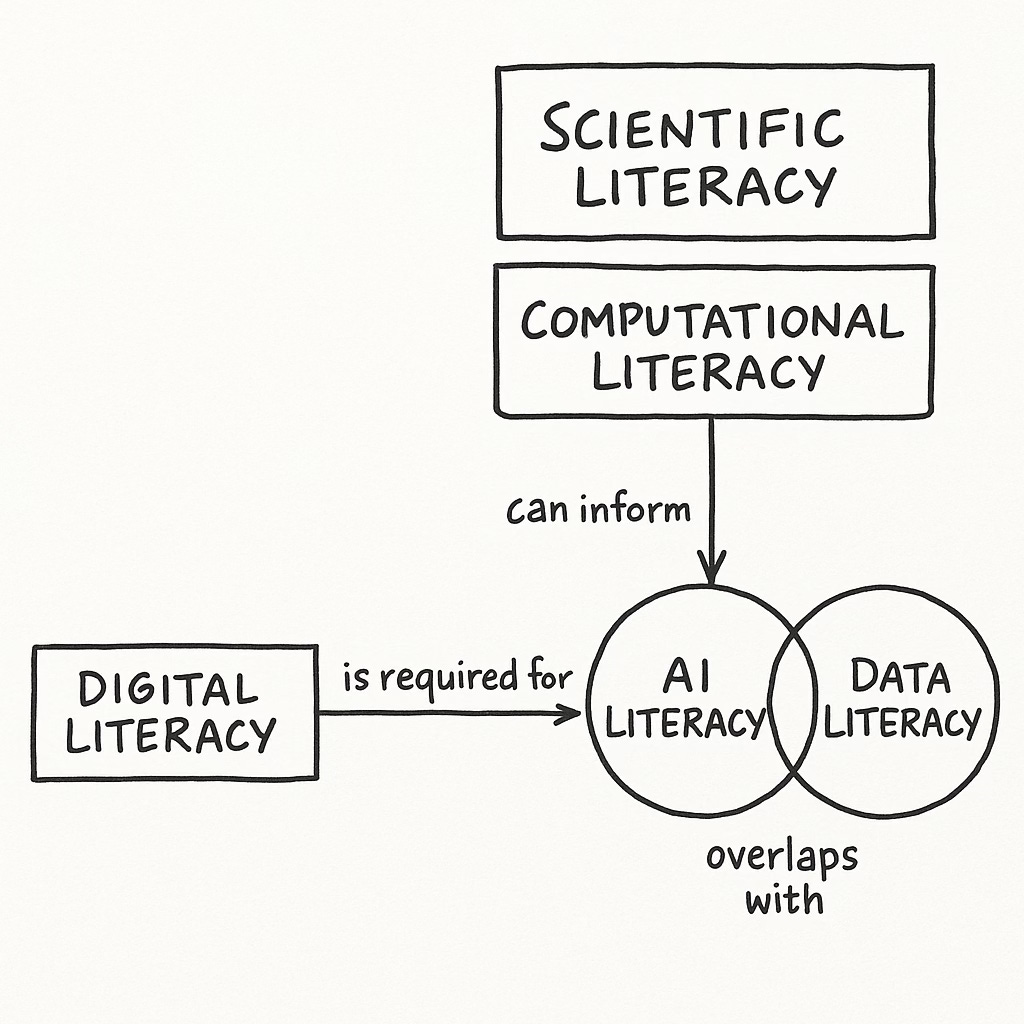
What is AI? — A simple question? Not really, but it’s the starting point for Long & Magerko (2020) to define what we mean by AI Literacy, which is quite distinct from other literacies related to digital technologies (see image)
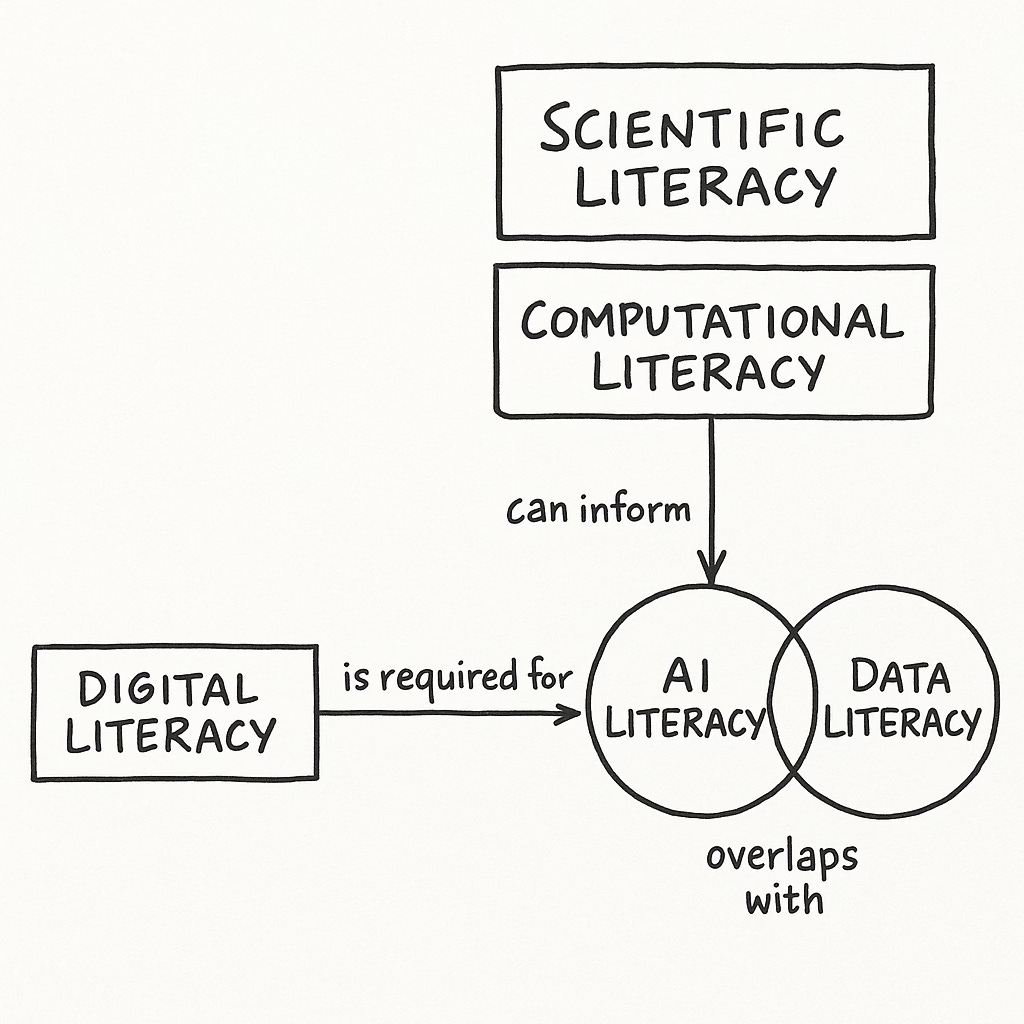
AI-elaboration from Long’s presentation of her paper (2020) AI problem solving
Real world AI
Machine learning
Neural networks
Implications — A quick dive into the narratives of AI and, conversely, the actual effects that AI technologies have on today’s society. This helps us focus our attention not just on the technology, but also on the contexts in which AI is produced and deployed.
Through chapters 2-5, you’ll learn the basics of AI systems, how they’re assembled, and the logic behind their functioning. The first and last chapters encourage reflection on the ethical and philosophical implications of AI technologies in society.
Now, these questions and thoughts are crucial.
You don’t need to (nor can you) become a computer scientist or AI Specialist overnight, by cramming hours of videos on YouTube or pages and pages of prompt engineering. What matters is how you engage with AI technologies at work and in your daily life, choosing between a mindless and mindful engagement with AI. Oleksandra Poquet (2022) suggests a mindful approach to AI, which necessarily requires knowing how AI operates (p. 6).
Poquet deliberately echoes Salomon and colleagues’ (1991) idea of intelligent technology (including AI) as partners in cognition. Discussing the effects with and effects of intelligent technology, Salomon and colleagues stress that just adopting a technology does not lead to higher intellectual performance, despite the promises of tech producers. Students using a computer in the 90s (or using GenAI in 2025) do not automatically enhance their learning. As they state in the article: “any partnership requires effort, and partnerships between humans and technology are no exception” (p. 4).
If we consider that technology is meant to decrease our efforts in performing our tasks, this idea might seem counterintuitive. Yet it means that we cannot always delegate our work to AI; automation has its limits if we aim for desirable results.
A mindful approach to AI is characterised by paying attention to its features and outcomes, without blindly relying on what it recommends or generates.
Given how fast and abundant text and image generation with AI tools has become, simple mantras like Pay attention! or Think critically! are not as easy to follow as they sound. Digital technologies push us to think (and act) fast, while considering whether AI-generated content is appropriate for our purposes requires pausing and reflecting. In this accelerated world, the role of the human users is to do what the machines cannot: think.
Being AI-literate does not mean being an AI expert. It’s not (just) about knowing the instrument, but rather about deciding — after thoughtful reflection — when and whether to use AI or not to perform our tasks. It’s an ethical dilemma.
Why?
To notice AI’s flaws and perks, it is essential to understand — at least generally — how AI works. Elements of AI is excellent for improving our AI Literacy.
Visually, this MOOC is very nice. Easy to navigate, accessible, and available in multiple languages, it offers a smooth digital learning experience for diverse audiences. It’s also regularly updated, and its Online community offers support, Q&As, and other news.
It alternates short and easy-to-read explanations with exercises, favouring an inductive, gamified approach. This allows you to learn by practical application and examples, making even complex computer science topics less intimidating for those who closed their maths books years ago.
For teachers, especially those who teach online or create digital learning materials, Elements of AI is also a source of inspiration for microlearning activities.
That said, Elements of AI requires some cognitive commitment. Didn’t we say that learning AI requires deliberate efforts?
By completing the 25 exercises, you’ll earn a certificate of completion for the MOOC. Don’t rush through the exercise! Once you sign in, you will get only one chance to complete them. There’s no risk of failing, but taking your time to walk through the MOOC and its exercises is worth it for a better learning experience.
What for?
Elements of AI stands out because it offers both technical and substantive content for beginner learners, regardless of background.
By completing this MOOC, you’ll learn the fundamentals of how AI systems work and begin reflecting on AI’s broader implications and narratives. You may need a few extra minutes to solve the exercises, but this effort is enough to gain a general understanding of a complex technology like AI. Plus, you can do it in the language you’re most comfortable with.
Elements of AI is also a valuable resource for teaching AI to your students, focusing on topics relevant to your context, selecting the most appropraite activities from the MOOC’s six chapters.
Considering its structure and accessibility, Elements of AI is one of the most important resources to keep in mind for teaching and learning AI.
E.
🍎 Are you a bookworm? Here’s your apple!
Anthony Elliot’s book (2019) has become something of a classic on AI’s role in our lives and societies. The book explores AI technologies and describes their applications across various sectors of economic and social life.
After an introduction on the history of AI, the author tackles interconnected themes such as automation, privacy, and communication in a world where AI is invisible, but pervasive.
I recommend this book for ayone wanting to grasp the complexities of AI, its entanglements with the complex systems of modern society, and its influence on our decisions and actions. If it’s true that our conscious reasoning starts with the act of noticing, after reading this book, AI will become far more visible to your eyes.
Click on the image to discover more about the book 📓
